When should a child begin to train, and why the old fear was wrong
Most parents think lifting weights is dangerous for children. Twenty years of paediatric consensus disagree, and the reason has more to do with the nervous system than with muscle.
Most parents think lifting weights is dangerous for children. Twenty years of paediatric consensus disagree, and the reason has more to do with the nervous system than with muscle.

Parents are told that writing by hand is vital for their child's growing brain, and that screens are eroding it. We sort the viral headlines from the solid evidence, and find the real benefit belongs to one group above all: children still learning their letters.
Your child's fussiness for food is mostly inherited, and most of the things parents try in order to fix it make it worse. Find out why young children refuse food, why it is rarely a parent's fault, and the unglamorous method that genuinely changes how they eat.
Strict digital rules protect young children, but research shows that for older teenagers, they often backfire. Shifting from a role where you control access to one where you offer advice builds the internal skills children need to navigate the internet safely when you are not there.


You walk into their bedroom and see the blue light reflecting off your teenager's face. You ask who they are talking to, or glance at the screen, and they snap the device shut. "It’s nothing," they say, sliding the phone into a pocket.
In that moment, you feel a distinct panic. You are not just worried about screen time. You are worried about the specific, messy reality of the digital world: the group chat drama that never sleeps, the algorithm serving up unrealistic body standards, the violent video games, or the comments section that feels like a brawl. Your instinct is to clamp down—to install monitoring software, tighten time limits, and demand passwords.
We do this because we want to protect our children. We assume that if we can control what they see—blocking the inappropriate websites, filtering the social media feeds—we can keep them safe.
But a comprehensive new wave of research analyzing adolescent development suggests that simply restricting access to the internet and social media does not work the way we think it does. While strict rules are effective for younger children, the data shows that for older teens, this approach is often associated with more risk, not less.
The evidence is becoming clear. The goal of modern parenting cannot be to simply block the internet. It must be to teach the child how to handle it. We need to shift from controlling their access to building their internal skills, so they can navigate the games, the chats, and the content when we are not there to watch.
The "Age-Grade Flip"
For years, the debate has been binary: are you a "strict" parent or a "permissive" one? The data now tells us this is the wrong question. The effectiveness of your strategy depends entirely on the age of your child.
Researchers call this the "Age-Grade Flip."
You are reading a free preview of The Inquisitive Parent. To unlock the rest of this feature - including the critical data on exactly when strict rules start to backfire, the truth about how surveillance apps drive secrecy, and the specific Age-Based Roadmap for navigating the digital world from age 10 to 18 - join us today.
In early adolescence (roughly ages 10 to 12), the part of the brain responsible for impulse control—the prefrontal cortex—is significantly underdeveloped. At this stage, your child lacks the biological hardware to fully regulate their own behavior.
A 2025 study published in the Journal of Medical Internet Research indicates that for children under the age of 12 (specifically under 12.3 years), strict rules—limiting hours, banning apps, controlling access—appear highly effective. These rules act as an external control system, stopping the habit before it starts.
But then, the flip happens.
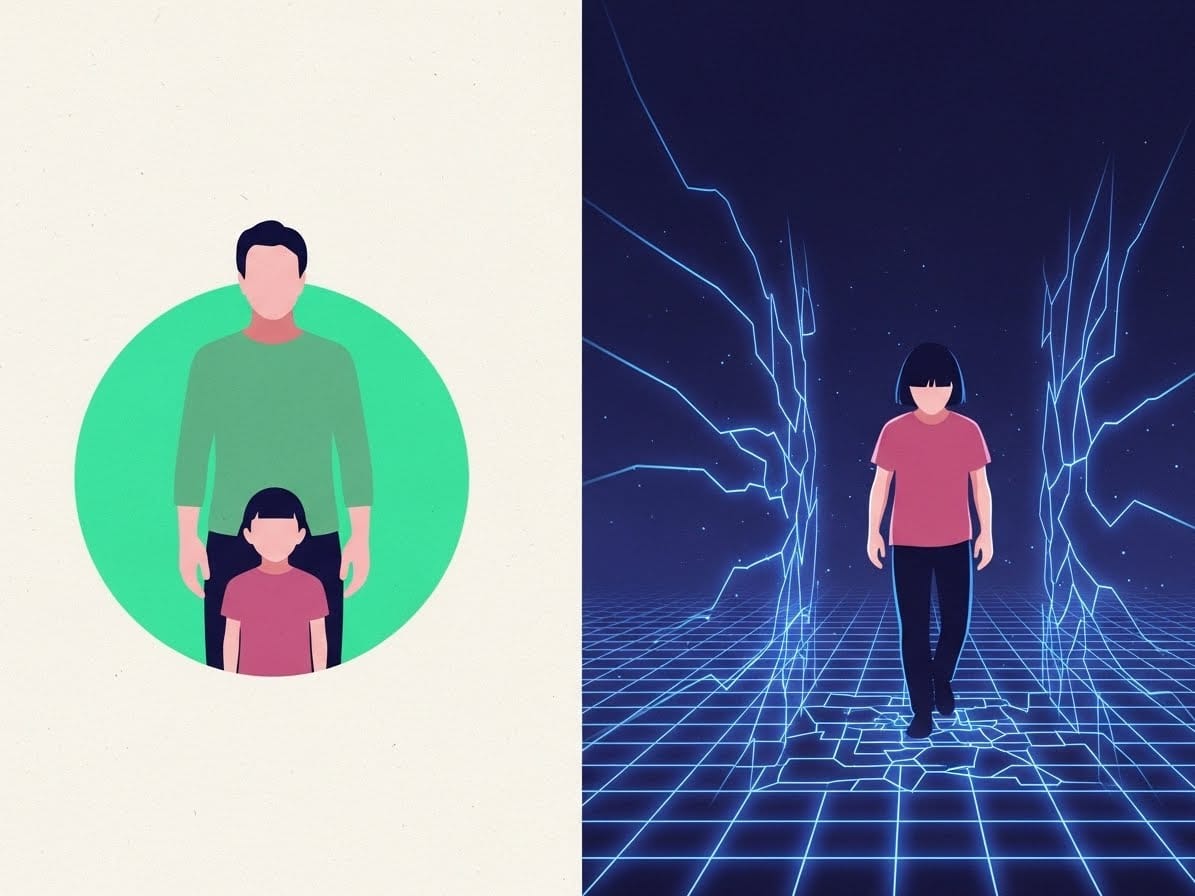
The same study reveals a critical turning point. As children cross into mid-adolescence, the effectiveness of strict rules appears to diminish. By age 15.7, rigid restrictions are no longer just ineffective; they are a statistical risk factor. The data suggests that for older teens, strict rules are associated with a higher likelihood of problematic social media use.
Why? Because of a mechanism known as "Psychological Reactance." When a 16-year-old feels their independence is threatened by rules they see as unfair, they don't just comply. They fight back to restore their control. They hide their behavior.
The Problem with Surveillance
This brings us to the most tempting tool for modern parents: surveillance apps.
It is easier than ever to track your child’s location, read their texts, and mirror their screens. It feels like safety. But research indicates that high levels of surveillance are often counterproductive, predicting higher levels of secrecy.
This has created a common behavior known as the "Finsta" (Fake Instagram). Your teen likely has a "Rinsta" (Real Instagram)—a polished, public account where they post harmless photos for you to see.
But the "Finsta" is where their actual life happens. It is locked, private, and shared only with a small circle of friends. It is where they post the content you are worried about—the risky photos, the unfiltered rants, or the interactions with strangers.
The danger here is the isolation. If your child encounters cyberbullying or predatory behavior on their private account, they cannot come to you. They know that revealing the problem reveals the secret account, which would lead to punishment. By trying to see everything, we often ensure we see nothing.

A Moment of Empathy
Let’s be honest about how difficult this transition actually is. Shifting your role from a "manager" who enforces rules to a "consultant" who offers advice sounds logical, but emotionally, it can feel like you are giving up. It feels like you are leaving your child unprotected in a dangerous environment.
If the thought of stepping back makes you anxious, you are not being irrational. You are simply parenting in a world that is entirely new. We are the first generation to raise teenagers with this level of technology, and we are all figuring it out without a map.
But the science is asking us to trust a different process: the slow, difficult work of teaching them to filter the world themselves. We want them to be safe not because we are watching, but because they know how to handle what they see.
Teaching Critical Thinking
So, if we can't just ban the phone, what do we do? We use "Active Mediation."
This means discussing the content rather than just blocking it.
When your teen is scrolling through TikTok or Instagram, their brain is often in a passive loop, seeking the next dopamine hit. Active mediation interrupts this loop.
It involves asking specific questions:
A 2025 review on executive function suggests that these questions encourage the adolescent to engage their critical thinking skills. You are helping them build the neural pathways required to analyze what they are seeing.
You are not forbidding the content; you are deconstructing it.

The Parent as the Variable: The Hardest Truth
There is one final factor in this equation, and it is the one we least like to discuss: ourselves.
We are not objective observers. We are participants. And often, we are distracted ones.
Researchers call this "Technoference"—interruptions in parent-child interactions due to digital devices. A major 2025 meta-analysis of over 60,000 participants found a significant connection between parental technoference and child problematic media use.
One theory explaining this dynamic is painful to consider. It is the "Accept-Rejection Theory." When you are scrolling through emails at dinner and your child tries to speak to you, and you hold up a finger to silence them, they may perceive this as rejection. They learn that the device is more interesting than they are.
To cope with this disconnection, they turn to their own screens to seek connection elsewhere. It is a feedback loop. We cannot ask our children to have a healthy relationship with technology if we are modeling a dependent one.

The Pivot: The Age-Based Roadmap
We need to move away from the "strict vs. permissive" debate and adopt a strategy that changes with age. Here is the framework.
Phase 1: The Safety Net (Ages 10–12)
Phase 2: The Training Phase (Ages 13–15)
Phase 3: The Consultant Phase (Ages 16+)
Summary
The digital world is too vast to be managed by rules alone. The only sustainable defense is to build your child's own ability to self-regulate. We need to equip them with critical thinking, self-control, and the secure knowledge that they can turn to you for help, not judgment.
2025, Geurts, S., et al., Parental Internet-Specific Rules and the Onset of Adolescents' Problematic Social Media Use: Prospective Study Testing Potential Moderators, Journal of Medical Internet Research.
2023, Liu, J., et al., Active Parental Mediation and Adolescent Problematic Internet Use: The Mediating Role of Parent–Child Relationships and Hiding Online Behavior, Behavioral Sciences.
2025, Shan, S., et al., Executive Functioning as Mediator in the Longitudinal Relationship Between Media Multitasking and Divergent Thinking in Adolescents, Journal of Psychology.
2025, Zhang, J., et al., Parental Technoference and Child Problematic Media Use: Meta-Analysis, Journal of Medical Internet Research.
2025, Morales-Álvarez, A., et al., Supportive parenting and adolescents digital citizenship behaviors: The mediating role of self-regulation, Cyberpsychology: Journal of Psychosocial Research on Cyberspace.

Most of what shapes a young life turns out to be joyful and ordinary. A major new study shows what teenagers themselves treasure, and why the way they answer can tell you how they are really doing.

Chronic pain in children is more common than being left-handed. And adults are surprisingly bad at reading how much pain a child is in. This is what all parents should know.

When a child receives a mental health diagnosis, whether anxiety, ADHD, depression, or something else, parents often want to know how it will impact their schooling. A new study provides some answers.

A major new study has scanned the brains of nearly 10,000 children and tracked them for three years. Its findings reveal which children are most at risk of loneliness, and what can be done to prevent it.