When should a child begin to train, and why the old fear was wrong
Most parents think lifting weights is dangerous for children. Twenty years of paediatric consensus disagree, and the reason has more to do with the nervous system than with muscle.
Most parents think lifting weights is dangerous for children. Twenty years of paediatric consensus disagree, and the reason has more to do with the nervous system than with muscle.

Parents are told that writing by hand is vital for their child's growing brain, and that screens are eroding it. We sort the viral headlines from the solid evidence, and find the real benefit belongs to one group above all: children still learning their letters.
Your child's fussiness for food is mostly inherited, and most of the things parents try in order to fix it make it worse. Find out why young children refuse food, why it is rarely a parent's fault, and the unglamorous method that genuinely changes how they eat.
New research from Estonia has quietly dismantled one of the most confident pieces of parenting advice of the past decade. Reducing your child's screen time matters - but what you replace it with matters far more.


Walk into any group of parents discussing toddler screen time and you will hear versions of the same conviction: less is more. Cut the tablets, limit the TV, and your child's brain will thank you. It is a position backed by the World Health Organisation, the American Academy of Pediatrics, and most family doctors. It is also, according to a study published in April 2026, only half the story.
The research, led by Jaan Tulviste at the University of Tartu in Estonia, followed 448 children aged between two and a half and four years old, measuring how much time they spent watching screens, how much time their parents spent on screens, and how much time the children spent in face-to-face conversation with adults. Then it compared all of that against the children's scores on a validated language assessment covering vocabulary, grammar, sentence complexity, and communication.
What the team found in the first part of the analysis was unsurprising: more screen time was linked to weaker language skills, and more conversation with adults was linked to stronger ones. Both associations held up independently, even after accounting for age and sex. Reassuring confirmation of what parents have long been told.
Then came the finding that changes things.
When the researchers grouped families by their actual patterns of behaviour - rather than just looking at one variable at a time - they found three distinct types of household.
The first, and largest, group (just over 43% of families) were high-screen across the board: children and parents both spent a lot of time on devices, though the children still had a moderate amount of conversation with adults. The second group (just over 40%) had low screen time for everyone - children were well within recommended limits - but also very little face-to-face talk. The third group (around 17%) had children with minimal screen exposure, parents with moderate use, and the highest levels of child-adult conversation of any group.
The children in that third group had significantly better language scores than both other groups. That was expected. What was not expected was this: the children in the low-screen, quiet homes did no better than the children in the screen-heavy homes. Statistically, there was no meaningful difference between them.
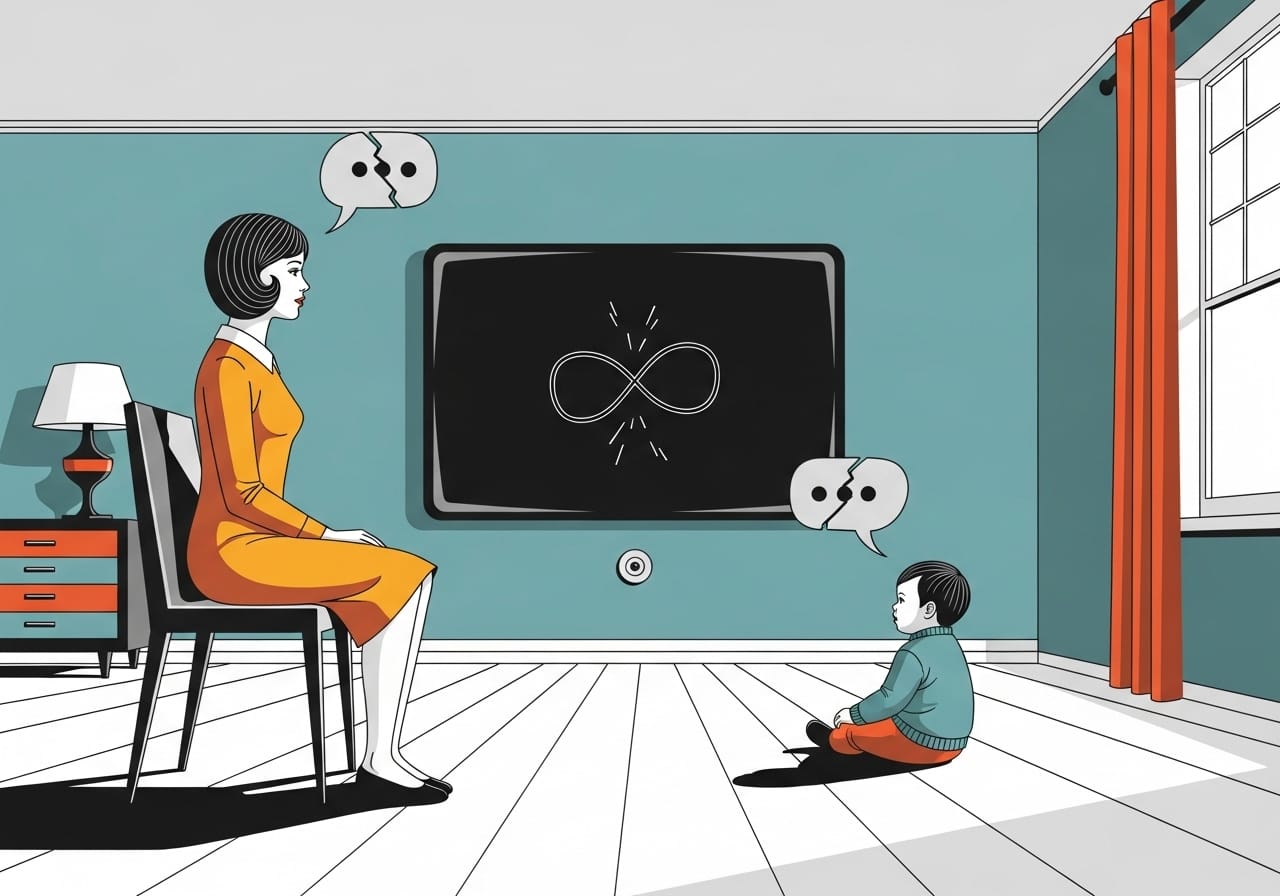
In other words, turning off the TV and then leaving a child in a quiet room produces the same language outcomes, on average, as leaving the TV on.
This is the finding that Tulviste's team calls the "Low-Screen, Quiet" anomaly - and it directly undermines the assumption that restriction alone is a form of protection.

The explanation for this sits in how language is actually built in a young child's brain. For decades, parents were told the key thing was the sheer volume of words a child heard - a message that emerged from landmark American research in the 1990s estimating that children from lower-income households heard tens of millions fewer words by age three than those from more affluent ones. Talk at your child more, the guidance said, and you will close the gap.
Neuroimaging research since then has revised that understanding considerably. What the brain appears to require is not a higher volume of words but a higher frequency of back-and-forth exchanges - moments where the child says or does something and an adult responds directly, and then the child responds in turn. These reciprocal conversations, even short ones, are associated with measurably greater activity in the parts of the brain responsible for language processing. Passive listening to adult speech, whether from a parent talking on the phone or a presenter on a children's programme, does not produce the same effect. The brain, at this age, needs a live partner who reacts to it.
This is why silence after screen removal is not neutral. Taking the device away successfully prevents one problem - the displacement of conversation by digital noise - but it does not solve the underlying need. If the device disappears and no conversation replaces it, the child's language environment has not improved in any meaningful way.
The Estonian study also included parental screen time in its analysis, which revealed something instructive. The families with the best language outcomes were not those where parents had no screen use themselves. They were the ones where parents had moderate use and children had high levels of face-to-face talk. This suggests that what parents do when they are not on a screen matters more than the amount of time they spend on one.
A parent who uses their phone for an hour while the child naps, and then spends two hours in active conversation, storytelling, and shared play when the child is awake, is creating a richer language environment than one who avoids screens but is largely quiet around the child.
None of this means screen time limits are pointless. The study still found an independent negative association between children's screen time and their language scores - meaning screens appear to cause some developmental friction beyond simply displacing conversation. Fast-paced content is a particular concern: other research has revealed experimental evidence that just nine minutes of watching rapid, high-stimulation cartoons can temporarily impair a four-year-old's ability to concentrate and regulate attention - exactly the cognitive tools needed to follow a conversation, stay with a story, or process new words.
The practical upshot of all of this is more specific than the standard advice tends to be. Limits on children's screen time remain worth keeping. But what this research asks parents to do is treat the time after the screen goes off as an active responsibility rather than a solved problem. A child who has just watched something and is then engaged with a parent in talking about it - even loosely - is in a better language environment than a child sitting quietly in a screen-free room. The content of what gets watched matters too: slow-paced programmes that follow the rhythm of real conversation appear to leave children more cognitively available for the interaction that follows.
The clearest message from Tulviste's work is the one that most guidelines have not yet caught up with. What builds language in young children is not the absence of screens. It is the presence of conversation - daily, reciprocal, unhurried, and directed at the child. That is what fills the gap. Everything else is just rearranging the furniture.
2026, Tulviste et al, High screen time and low child-adult talk associated with poorer language development in early childhood, Frontiers in Developmental Psychology


Most parents think lifting weights is dangerous for children. Twenty years of paediatric consensus disagree, and the reason has more to do with the nervous system than with muscle.

Parents are told that writing by hand is vital for their child's growing brain, and that screens are eroding it. We sort the viral headlines from the solid evidence, and find the real benefit belongs to one group above all: children still learning their letters.

Your child's fussiness for food is mostly inherited, and most of the things parents try in order to fix it make it worse. Find out why young children refuse food, why it is rarely a parent's fault, and the unglamorous method that genuinely changes how they eat.

Most of what shapes a young life turns out to be joyful and ordinary. A major new study shows what teenagers themselves treasure, and why the way they answer can tell you how they are really doing.