When should a child begin to train, and why the old fear was wrong
Most parents think lifting weights is dangerous for children. Twenty years of paediatric consensus disagree, and the reason has more to do with the nervous system than with muscle.
Most parents think lifting weights is dangerous for children. Twenty years of paediatric consensus disagree, and the reason has more to do with the nervous system than with muscle.

Parents are told that writing by hand is vital for their child's growing brain, and that screens are eroding it. We sort the viral headlines from the solid evidence, and find the real benefit belongs to one group above all: children still learning their letters.
Your child's fussiness for food is mostly inherited, and most of the things parents try in order to fix it make it worse. Find out why young children refuse food, why it is rarely a parent's fault, and the unglamorous method that genuinely changes how they eat.
When your child ignores a simple instruction, it often feels like defiance. But neuroscience shows they are not choosing to ignore you - their developing brain literally did not process your voice. Discover the biology behind this, and what you can do

You are standing in the kitchen, and you ask your child to do something standard, like put on their shoes or turn off the television. You wait, and nothing happens. You repeat the request, perhaps a bit louder. When you eventually raise your voice, your child looks up, genuinely startled.
If you feel a sudden heat of frustration in these moments, worrying that your child is ignoring you, it is entirely understandable. Previous generations of parents generally categorized this behavior as straightforward defiance.
We have often assumed the child heard the instruction, processed it, and made a calculated choice to continue playing, frequently referring to this as "selective hearing."
However, recent scientific research suggests something very different is going on.
Often, your child is not ignoring you. Due to the way their developing brain processes sensory information, they literally do not hear you.
The reason is because your child's auditory system does not capture every sound in their environment equally. It has to manage competing sensory information, and it shifts focus based on what is happening around them.
Understanding the biology of this process helps explain why our instructions sometimes fail to register. It also suggests how we may more effectively communicate with our children, whose brains are still developing.

Inattentional Deafness
The primary reason your child does not register your instructions is a neurological condition known as inattentional deafness.
Historically, psychologists assumed that hearing and seeing operated independently. Research has since established that the brain has a limited capacity for attention, and the visual and auditory systems share this neural resource.
When your child is looking at something visually complex - whether a screen, a detailed book, or a toy - their brain has to process too much visual information, and that can overwhelm their capacity to pay attention to other things. To maintain focus on what they are seeing, their brain temporarily suppresses their ability to process sound.
A foundational 2015 study by Molloy and colleagues demonstrated this effect, showing that high visual focus directly reduces auditory processing in the brain.
Recent data from 2025 further details how environmental factors exacerbate this in children. A study published in Applied Sciences demonstrated that environmental noise in classrooms does more than just distract your child; it actively reduces their ability to hold information in their mind and focus on what is in front of them, with the same likely true at home.

When your child is concentrating visually, filtering out moderate background noise - such as a dishwasher running or nearby conversations - requires substantial cognitive effort.
This processing demand leaves them with insufficient neural capacity to register a sudden verbal instruction. The sound wave enters their ear, but their brain does not process the signal into conscious awareness.
This is a failure of perception, not a behavioral choice. Your child does not look up because they genuinely did not hear you speak.
Achieving Neural Synchrony
When trying to gain your child's attention, standard advice has often been to establish eye contact. However, current neuroscience indicates that successful communication relies on a more involved process called interpersonal neural synchrony.
Using functional near-infrared spectroscopy (fNIRS) - a technology where participants wear a cap fitted with light sensors to safely measure blood flow in the brain - researchers can observe the brain activity of a parent and child simultaneously during an interaction.
A 2024 study in Developmental Science examined parents and children solving tasks together. The researchers found that communication relies on the synchronization of brain waves. Crucially, this study established that this neural synchronization depends heavily on positive interaction.
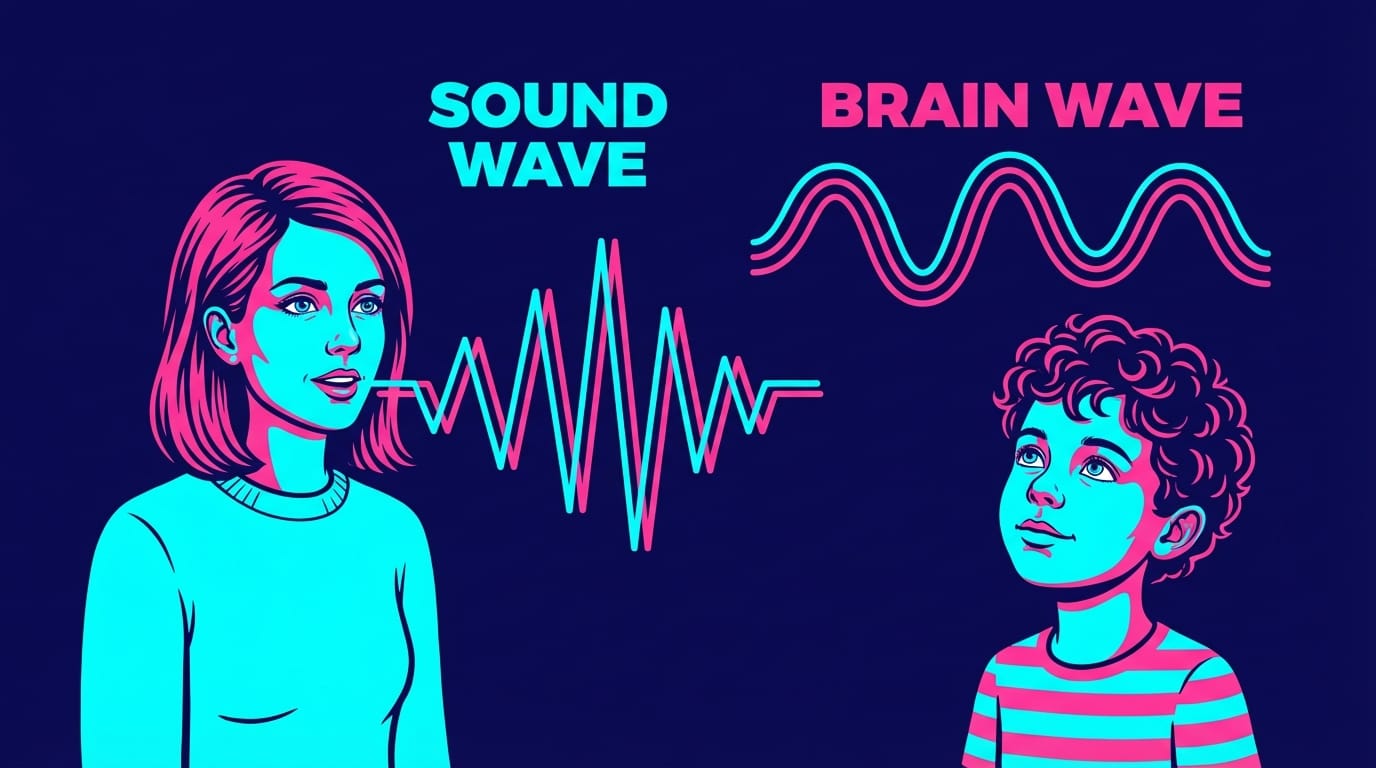
When the parent provided positive feedback and the child was in a good mood, their brain activity synchronized, making communication effective. When interactions are stressful or highly controlling, this neural connection drops.
A 2025 study in Imaging Neuroscience supports this finding, demonstrating exactly how your own background stress disrupts communication. When you are stressed, your speech and physical movements naturally accelerate. Your child’s brain, which processes information at a slower pace, cannot align with this faster, unpredictable rhythm.
As a result, the shared biological rhythm between your two brains drops, preventing your child from actually processing your verbal instructions.
Increasing the volume of your voice does not resolve this lack of synchronization.
Don't Repeat Yourself
As parents we also often respond to this situation by repeating our ignored instruction multiple times.
But from a neurological perspective, this is counterproductive. The human brain is structured to ignore repetitive stimuli through a process called habituation. If you repeat sound without anything else changing, your child's brain categorizes it as uninformative and stops paying attention to it.
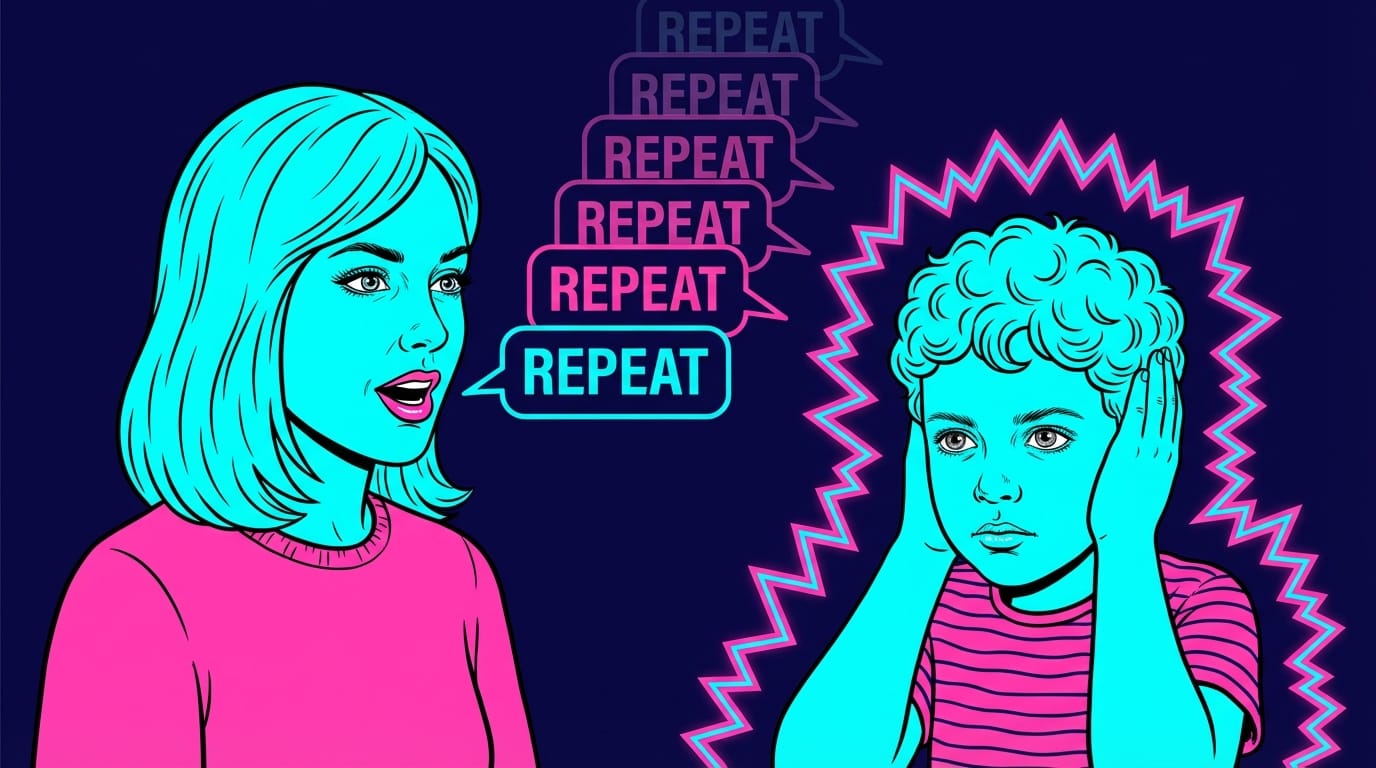
Furthermore, recent research outlines a distinct mechanism called active avoidance. A 2025 review in Current Topics in Behavioral Neurosciences details how the brain can identify specific stimuli as aversive and actively inhibit the neural pathways responsible for processing them.
If your instructional tone is frequently associated with interruption or stress, your child’s brain may utilize these avoidance circuits to block the auditory input before it reaches their conscious awareness. In these instances, their brain is actively suppressing the sound of your voice.
The Adolescent Shift
Parents of adolescents often observe that their teenager seems to stop listening to them entirely. This behavioral change corresponds with structural changes in the social brain. For children under the age of ten, a mother’s voice is highly salient. Functional MRI scans indicate that hearing their mother’s voice activates both auditory processing centers and reward circuits in the brains of younger children.
However, a well-established 2022 study published in the Journal of Neuroscience showed that around age 13, the adolescent brain ceases to register the mother's voice as uniquely rewarding.

Instead, the brain shows increased activation in response to unfamiliar voices and peers. This neurobiological shift is a necessary part of adolescent development, directing your child's attention away from the family unit and toward the broader social environment they need to navigate. Consequently, your voice loses its previous impact.
Evidence-Based Communication Strategies
Recognizing that your child's brain is susceptible to inattentional deafness, impaired by background noise, and capable of habituating to repeated instructions allows you to adjust how you communicate. The following strategies align with the current understanding of pediatric neurobiology:

So in summary, remember, when your child fails to respond, it is rarely a personal slight. It is the result of their developing nervous system managing a complex sensory environment.
Understanding the biological mechanisms behind this behavior allows you to communicate in ways that are compatible with your child's neurological development.
2015, Molloy, K. et al., Inattentional Deafness: Visual Load Leads to Time-Specific Suppression of Auditory Evoked Responses, Journal of Neuroscience.
2022, Abrams, D.A. et al., A Neurodevelopmental Shift in Reward Circuitry from Mother's to Nonfamilial Voices in Adolescence, Journal of Neuroscience.
2024, Li, Y. et al., Eye of the beholder: Neural synchrony of dynamically changing relations between parent praise and child affect, Developmental Science.
2025, St. Clair, V. et al., Analytical pipeline optimisation in developmental fNIRS hyperscanning data: Neural coherence between 4- to 6-year old children collaborating with their mothers, Imaging Neuroscience.
2025, McManus, H. and Milad, M.R., Behavioral and Brain Mechanisms of Active Avoidance and Their Relevance to Anxiety Disorders, Current Topics in Behavioral Neurosciences.
2025, Pittana, I. et al., Influence of Noise Level and Reverberation on Children's Performance and Effort in Primary Schools, Applied Sciences.

Most parents think lifting weights is dangerous for children. Twenty years of paediatric consensus disagree, and the reason has more to do with the nervous system than with muscle.

Parents are told that writing by hand is vital for their child's growing brain, and that screens are eroding it. We sort the viral headlines from the solid evidence, and find the real benefit belongs to one group above all: children still learning their letters.

Your child's fussiness for food is mostly inherited, and most of the things parents try in order to fix it make it worse. Find out why young children refuse food, why it is rarely a parent's fault, and the unglamorous method that genuinely changes how they eat.

Most of what shapes a young life turns out to be joyful and ordinary. A major new study shows what teenagers themselves treasure, and why the way they answer can tell you how they are really doing.