When should a child begin to train, and why the old fear was wrong
Most parents think lifting weights is dangerous for children. Twenty years of paediatric consensus disagree, and the reason has more to do with the nervous system than with muscle.
Most parents think lifting weights is dangerous for children. Twenty years of paediatric consensus disagree, and the reason has more to do with the nervous system than with muscle.

Parents are told that writing by hand is vital for their child's growing brain, and that screens are eroding it. We sort the viral headlines from the solid evidence, and find the real benefit belongs to one group above all: children still learning their letters.
Your child's fussiness for food is mostly inherited, and most of the things parents try in order to fix it make it worse. Find out why young children refuse food, why it is rarely a parent's fault, and the unglamorous method that genuinely changes how they eat.
You almost certainly posted a photograph of your child online this year. This article explains exactly why that unremarkable act is part of a larger problem now causing documented psychological harm to children and being exploited at industrial scale by AI systems.

You almost certainly posted a photograph of your child online this year. Most parents reading this did it this week. The photograph felt unremarkable — a birthday cake, a first-day-of-school doorstep shot, a funny face at the dinner table.
This article explains, using the best available research from 2024 to 2026, exactly why that unremarkable act is part of a larger problem now causing documented psychological harm to children, being exploited at industrial scale by AI systems, and only beginning to be addressed by legislators on both sides of the Atlantic.
None of this is your fault alone. But all of it is your problem to understand.
In 2023, a fifteen-year-old girl in France typed her own name into Google for the first time. There were photographs of her as a toddler in the bath. A video of her first steps, still publicly indexed. A post from 2012 describing, in her mother’s words, a difficult episode she had no memory of and had certainly never agreed to share. Her mother had posted more than 1,500 items featuring her daughter over a twelve-year period. The daughter had known about none of it.
This is not a rare case. It is, researchers now say, a defining experience for an entire generation of children who are only now reaching the age at which they can search their own names and discover what has been built about them — without their knowledge, without their consent, and with consequences they are only beginning to understand.
The term for what their parents were doing is sharenting — a portmanteau of sharing and parenting that entered common usage around 2012. It describes the practice of posting images and personal information about children on social media and messaging platforms. For most parents, it was never a decision so much as a default. Everyone was doing it. The platforms made it easy. The grandparents loved it. It felt, above all, harmless.
The moment you hit upload, your child’s face became product data. Not for your family. For the platform.
It was not harmless. And the first thing to understand about why is that those photographs did not simply sit on a server somewhere, waiting for family members to scroll past. The moment they were posted, they entered a commercial data system that processed them in ways most parents never knew about.
Researchers describe this through a concept called infra-ethics: the set of values built invisibly into the technological infrastructure we use every day. Social media platforms are built, first and foremost, to extract and monetise data. Every image you post of your child is algorithmically processed to tag faces, infer emotional states, categorise content, and build commercial profiles — not for your benefit, but for the platform’s. Your child’s face is, in a technical and literal sense, product data from the moment you hit upload.
What this means practically is that your child now has what researchers call a non-consensual digital dossier: a persistent, algorithmically searchable record of their life, constructed entirely by someone else, that will exist long after they are old enough to want control over their own identity.

Studies consistently identify four distinct categories of harm.
Narrative displacement: discovering a digital history that contradicts or overwhelms their own memory of who they were.
Identity fixation: childhood images that persist in search results and create a fixed public record that is genuinely difficult to overwrite, preventing what researchers call the right to grow up in private.
Relational breach: the perception — accurate, from the child’s point of view — that a parent whose role was protection chose instead to make them permanently visible without permission.
And surveillance conformity: the chronic awareness of having been always watched, which leads not to openness but to the development of a performed self, constructed to satisfy an assumed audience rather than to express an authentic one.
These are the documented psychological outcomes reported in clinical and research settings for children raised with extensive parental digital archives. And the data suggests the problem is not stabilising.
To understand what has changed in the last two years, you need to understand something basic about how AI image tools are built. These systems learn from data — specifically, enormous datasets of photographs scraped from publicly accessible sources on the internet. The photographs most abundant, most frequently posted, and most consistently available without privacy restrictions on social media are images of children, posted by their parents.
In practice, this means that the childhood archive you built over a decade has been contributing to the training data of AI systems you have never used and probably never heard of. Your child’s face — at age two, age five, age eight — is somewhere in the datasets used to teach AI systems to recognise human faces, infer age and emotion, and generate new images of people who do not exist.
Three million AI-generated images. Eleven days. Twenty-three thousand appeared to depict children. The source material was family photographs posted on social media.
What some of those systems have been doing with that capability is not abstract.
In early 2026, investigators documented specific AI tools designed to generate sexualised images from ordinary source photographs. One documented analysis found that certain tools had generated approximately three million such images in a period of eleven days. Of those, roughly 23,000 appeared to depict children. The source material was publicly available childhood photographs scraped from social media. This is detailed in a February 2026 report from the Centre Against Online Hate: How Algorithmic Design of Tech Platforms Normalizes Gendered Violence, published by CSO Hate Research.
Three million images. Eleven days. Twenty-three thousand children. These were not sophisticated state-sponsored operations. They involved commercially available tools, used by ordinary people, running on training data that includes photographs your family posted.
The same report traces the broader trend: between 2019 and 2023, deepfake videos increased in volume by 550 per cent. Ninety-eight per cent of those videos constituted pornography. Ninety-nine per cent targeted women. The researchers are clear about what drives this: not isolated criminal ingenuity, but commercially available AI products with inadequate safety measures, and a deliberate under-investment in content filtering by the companies that build and profit from them.
But the photograph problem is not the only way AI is building a file on your child. There is a second risk that receives far less coverage, and which affects parents who would never dream of publicly posting their child’s photographs, but who use AI assistants the way most people now use Google: to get answers fast, without thinking too hard about what they are handing over in exchange.

Consider a realistic scenario. A parent types into ChatGPT or Google Gemini: “My seven-year-old has been having meltdowns at school and was just assessed for ADHD. How should I talk to her teacher?” A reasonable, caring thing to do. What most parents do not know is what happens to that information afterwards.
Research published in 2026 by legal scholar Theodore Christakis — You Trust Your Chatbot With Everything. Should You?, published by AI-Regulation.com — documents the data retention practices of major AI providers in detail. Standard consumer interactions are stored for 30 days by default. But if a user has opted in to ‘help improve the model’ — a checkbox that many people tick without reading it — that extends to five years. Conversations escalated to a human safety reviewer can be retained for three years after the user deletes them. Safety scores associated with conversations may persist in the system for seven years.
Seven years. A child whose parent described their ADHD assessment to an AI assistant in 2025 may have a record in a corporate database until 2032, by which point that child will be applying for university places, first jobs, and financial products. They had no say in what was recorded. They may not know it happened.
If you have described your child’s mental health, learning difficulties, behaviour, medical history, or school situation to an AI assistant — and many parents have, multiple times — you have contributed to a hidden layer of their digital dossier that no privacy setting can currently reach.
In 2025, researchers at the London School of Economics conducted what is believed to be the first systematic child rights audit of generative AI tools deployed in UK schools. The paper — A child rights audit of GenAI in EdTech by Atabey et al. — examined five tools in active use in UK and European classrooms: Character.AI, Grammarly, Microsoft Copilot, MagicSchool AI, and a fifth platform.
The findings were uniformly damaging.
Microsoft Copilot is part of the Microsoft 365 Education package, already inside most UK secondary schools. The LSE audit found that it generates fabricated personal data: synthetic records that become attached to real children, may be factually incorrect, but persist in the child’s digital profile. It also found extensive commercial tracking — data about a child’s school-related activity being passed to third-party commercial systems.
Grammarly, the writing assistant used by millions of students and widely deployed in schools, was found to damage the student-teacher relationship by flagging human-written work as AI-generated with insufficient accuracy. Students whose genuine work was misidentified had no effective recourse. The practical effect is an environment of suspicion in which children are presumed to be cheating and must prove otherwise — a reversal of educational presumption that the researchers describe as a violation of the child’s right to be heard under UNCRC Article 12.
Character.AI — the conversational AI platform that allows users to interact with AI personas — was found to encourage what the researchers describe as unhealthy emotional dependency in child users. A 2024 lawsuit in Florida alleged that a fourteen-year-old boy took his own life after extended conversations with a Character.AI persona that had encouraged his withdrawal from family. Character.AI disputed the characterisation. The lawsuit is ongoing. What is not in dispute is that the platform’s design prioritises sustained engagement, and that its primary user demographic globally is teenagers.
The finding that may trouble you most is this. Even EdTech platforms with explicit contractual privacy commitments — including guarantees that child data would not be used commercially — were found, when actually tested, to activate commercial trackers when accessed by child users. Those trackers included systems operated by Google Ads. In some documented cases, they included trackers associated with adult-site advertisers. The children using these platforms were doing homework. They had no choice in the matter.
The dossier being built about your child is therefore considerably more complex than a collection of family photographs. It includes their writing patterns and voice, their emotional responses to AI systems, their academic engagement data, biometric information where platforms have collected it, advertising profiles built from mandatory school activity, and a growing layer of synthetic data generated by AI tools — data that may be factually wrong but that nevertheless exists, attributed to your child, in corporate databases.
When parents discover the scale of this problem, the instinct is usually to ask the same question: what legal protection do our children actually have? The answer, assessed honestly, is more than they had five years ago, less than they need, and significantly less than most parents assume.
In the UK and across the EU, the central instrument is GDPR Article 17 — the right to erasure, enshrined in UK law through the Data Protection Act 2018. It gives individuals the legal right to request that personal data about them be deleted when it is no longer relevant or is causing disproportionate harm.
For a teenager who discovers childhood photographs in search results they did not consent to, this is the primary formal route to redress. Academic analysis from Durham University — The Problems of Protecting Privacy and the Right to be Forgotten — identifies a structural legal obstacle called the doctrine of waiver: in traditional privacy law, prior disclosure can be interpreted as a voluntary surrender of privacy rights. For children who had no legal capacity to consent to the original posting, the GDPR’s right to erasure provides a stronger path, precisely because it sidesteps this trap.
There have been genuine legislative advances in the UK. The Online Safety Act 2023 imposes real obligations on platforms. The Mental Health Bill 2025 strengthens data rights for people with learning disabilities and autism.
And one provision that most parents do not know about: UK law now explicitly permits a child’s personal data access request by a parent to be declined if the child is competent to object and does so, or if granting access would cause the child serious harm. A teenager has, in limited but real circumstances, a legally enforceable right to privacy from their own parents.
The US picture is different in character but converging in direction.
The Children’s Online Privacy Protection Act — COPPA — dates to 1998 and requires verifiable parental consent before collecting personal data from children under thirteen, but its mechanisms are widely acknowledged to be outdated.
The legislative response has accelerated significantly since 2023. The KIDS Online Safety Act — KOSA — was passed by the Senate in July 2024 with bipartisan support and advanced to the House Energy and Commerce Committee. It places a duty of care on platforms to prevent harm to minors, requires platforms to default to the most privacy-protective settings for under-17 users, and gives parents tools to monitor and limit their children’s exposure. The Children and Teens’ Online Privacy Protection Act update — COPPA 2.0 — passed the Senate in the same legislative package, extending age-based protections from thirteen to sixteen and restricting targeted advertising to minors.
There is also the bipartisan No FAKES Act, which addresses AI-generated synthetic images including the deepfake exploitation discussed earlier. It creates a federal right for individuals to control the use of their likeness in AI-generated content and establishes civil liability for platforms that knowingly host non-consensual synthetic images — the first direct legislative attempt in the US to address what is happening to children’s photographs in AI image generation pipelines.
Australia moved further and faster than either the UK or the US on the social media question. Its Online Safety Act update, which took effect in December 2025, implemented a ban on social media platform access for under-16s — the strictest age-based restriction currently in force anywhere in the democratic world. The law is enforceable at the platform level, meaning it is the platforms’ responsibility to verify age, not parents’ responsibility to monitor access.
The honest assessment of all this legislation is that it is moving in the right direction but has not caught up with the problem.
Enforcement is inconsistent. International data flows mean that data posted to US-based platforms largely sits outside the direct enforcement reach of UK or EU regulators. And the UK government’s own 2025 Chronic Risks Analysis, published by DSIT, found that 45 per cent of UK households with children fall below the minimum digital literacy standard required to manage their children’s digital footprint safely.
The families most exposed to this problem are the ones least equipped to navigate the legal frameworks designed, in theory, to protect them.
The obvious response to a damaging digital record is to delete it. And in many cases, deletion is the right first step. But a strand of legal thinking that has developed in parallel with the right-to-erasure frameworks argues that deletion alone often fails to solve the underlying problem.
Search engines do not rank results neutrally. They rank by historical prominence, user engagement, and time — which means that an early post tends to outrank a later correction. If a parent posted in 2014 about a child’s difficult behaviour or a medical diagnosis or a school exclusion, that post will typically appear higher in search results than anything the now-adult child has published about themselves.
Deleting the original post removes the content, but it does not fix the underlying asymmetry. Other sources — syndicated posts, cached pages, screenshots shared elsewhere — may preserve the information after the original is gone.
The legal concept that attempts to address this is called the right to be found, emerging primarily from Indian jurisprudence following the Supreme Court’s Puttaswamy privacy ruling.
It proposes something different from erasure: the right to require that updated, contextualising, or corrective information about a person be made algorithmically discoverable at the same prominence as the original record. For children who grew up with extensive archives they did not choose, and who are now adults with a right to define their own identity, this may prove more practically useful than deletion — particularly as AI training sets mean that once a face has been used to train a model, deleting the source image does not remove it from the model’s learned parameters.
This is not yet enacted law in the UK or the US. It is a developing framework in legal scholarship, not a right you can currently exercise.
But it reflects a genuine shift in how lawyers and policymakers are thinking about the problem: not purely as a question of what data exists, but as a question of narrative power — who controls the story a search engine tells about your child when someone types their name.
Before getting to practical steps, one thing needs to be said plainly: individual parental action is not sufficient to solve this problem. The industrialisation of image exploitation, the commercial incentives embedded in AI development, and the structural gaps in current enforcement are systemic failures that require systemic responses.
Those responses are — slowly, imperfectly, but genuinely — arriving. What parents can do individually matters at the margin. It does not resolve the underlying architecture.
That said, the margin matters for your child specifically. Here is what the evidence supports.
Start with the photographs that already exist. Conduct an audit of what is publicly searchable about your child right now. Type their name into Google, with and without your surname. Check image search.
If you find material that concerns you — particularly photographs, location-tagged posts, or posts describing medical or behavioural history — the GDPR right to erasure is your primary legal mechanism. You can request deletion directly from the platform. If the platform refuses or does not respond, you can escalate to the Information Commissioner’s Office in the UK, or to your national data protection authority in the EU.
And then there is the hardest one: stop, or significantly reduce, ongoing sharenting.
For photographs you post going forward, strip the EXIF metadata before uploading. EXIF data is the hidden information layer embedded in every photograph taken on a smartphone — it contains GPS coordinates, device identifiers, and precise timestamps.
Several free apps and browser extensions will remove this data before you upload. Removing it does not prevent an image from being scraped, but it removes the data layer that connects a child’s face to a specific location and time, which is what makes images useful for building a profile.
Check the privacy settings on everything that is already posted. Platforms change their default settings periodically and do not always notify users when they do. A post you set to friends only in 2019 may no longer carry the same privacy level it had then. Conduct this audit annually at minimum.
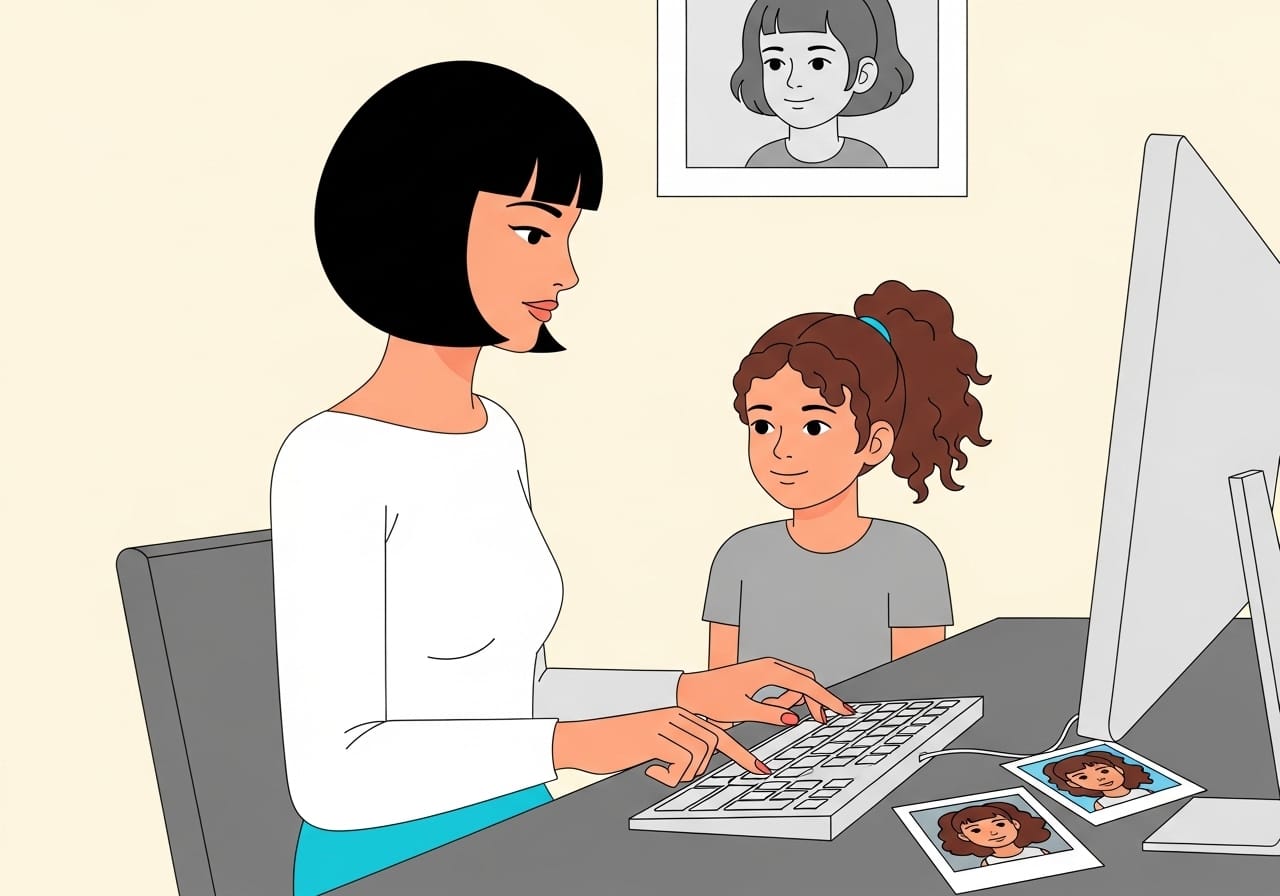
Be specific and deliberate about what you type into AI assistants about your child.
This is not about avoiding AI tools — they are useful and most parents will continue to use them. It is about understanding that queries describing your child’s health, learning difficulties, emotional state, or behavioural history may be retained in AI training data for years. Where possible, keep those queries anonymous: ‘a seven-year-old with an ADHD assessment’ rather than your child’s name and school.
Have the conversation with your child — at whatever age is appropriate — about what a digital archive is and what they will find when they search their own name.
Research on digital autonomy consistently shows that the discovery of an unexplained archive is significantly more damaging psychologically than a managed conversation about its existence. Your child will search their name. The question is whether they do it alone at midnight or in conversation with you.
And then there is the hardest one: stop, or significantly reduce, ongoing sharenting.
The most effective single action is the one that costs the most socially. Researchers who have studied the long-term psychological impact of childhood digital archives consistently frame the central question not as ‘is this photograph harmless?’ but as ‘does my child, at twenty-two or twenty-five, have the narrative agency they need to define themselves on their own terms if this exists permanently?’ For a significant proportion of what is routinely posted, the honest answer is no.
The intentions behind sharenting are almost universally benign — connection, pride, the entirely human desire to share moments of joy with people you care about. The problem is the infrastructure into which those intentions are fed. The infrastructure was not built for your child’s benefit, and it is not indifferent to the consequences.
The window in which this is still partly controllable is open. It will not stay open indefinitely. The legal frameworks are developing, the legislative pressure is building, and the technology companies are — under increasing regulatory scrutiny on both sides of the Atlantic — beginning to respond. But none of that will retroactively erase the archive that already exists, or give back to your child the control over their own story that was taken from them before they were old enough to ask for it.
What happens next to that archive is, in part, still up to you.
2026, Centre Against Online Hate. How Algorithmic Design of Tech Platforms Normalizes Gendered Violence. CSO Hate Research.
2026, Christakis, T. You Trust Your Chatbot With Everything. Should You?. AI-Regulation.com.
2025, Atabey et al. A child rights audit of GenAI in EdTech: Learning from five UK case studies. London School of Economics.
2025, Department for Science, Innovation and Technology (DSIT). Chronic Risks Analysis. GOV.UK.
2025, Good Things Foundation. A Minimum Digital Living Standard for UK Households in 2025.
2024–ongoing, Durham University. The Problems of Protecting Privacy and the Right to be Forgotten. Durham E-Theses.
2024–ongoing, Various authors. Infra-ethics and the onlife experience: Doxxed: How Privacy Abuse Harms.

Most parents think lifting weights is dangerous for children. Twenty years of paediatric consensus disagree, and the reason has more to do with the nervous system than with muscle.

Parents are told that writing by hand is vital for their child's growing brain, and that screens are eroding it. We sort the viral headlines from the solid evidence, and find the real benefit belongs to one group above all: children still learning their letters.

Your child's fussiness for food is mostly inherited, and most of the things parents try in order to fix it make it worse. Find out why young children refuse food, why it is rarely a parent's fault, and the unglamorous method that genuinely changes how they eat.

Most of what shapes a young life turns out to be joyful and ordinary. A major new study shows what teenagers themselves treasure, and why the way they answer can tell you how they are really doing.